


Gathering-Solutions for food safety


Welcome to The Gathering
Welcome back to The Gathering! This issue, we're digging into why knowing where your food comes from matters more than ever, sharing all the ways you can join us out in the community this summer, and reflecting on the real people whose lives are a little richer because of this work. Grab a cup of tea (maybe one you'll learn to make yourself — more on that below) and read on.


Practice | What we are growing and learning
Summer heat brings challenges
It's the kind of summer that makes you want to eat nothing but big salads and platters of crisp veggies with dip. So it's a little frustrating that public health officials are telling us to be careful with raw produce right now, of all times. Why is that happening — and what does it tell us about how our food actually gets to our tables?
Here's the short version: there's a larger-than-usual outbreak of cyclosporiasis this summer. Cyclospora is a parasite that gets into the food or water supply through contact with human waste, and it can cause severe, recurring diarrhea that lasts for weeks. It's rarely life-threatening, but it can hit children, older adults, and anyone with a weakened immune system especially hard. Cases have shown up in more than 30 states, with Michigan seeing the largest numbers by far — thousands of cases there alone. Health officials still haven't pinned down the exact source, though early signs point toward lettuce and other leafy greens from very large farms.
So how does a parasite end up on your salad in the first place? A few ways: irrigation water that's been contaminated by human waste, fertilizer made with treated sewage or biosolids, or farmworkers who don't have adequate bathroom access while out in the fields. Investigators are still tracing this particular outbreak, but the largest ones so far appear to trace back to large national produce distributors — the kind of operation where a single contamination point can end up mixed into shipments bound for dozens of states before anyone catches it.
Making matters harder: earlier this year, federal budget cuts scaled back the CDC's FoodNet program, which tracks foodborne illness trends, and Cyclospora was one of the pathogens dropped from active surveillance. With less consistent tracking in place, it takes longer to spot outbreaks like this one and pin down where they started.
We focus on solutions
Food grown closer to home works differently, and there are a few specific reasons why:
Shorter supply chain. On a smaller farm, the grower is the one walking the rows, watching the harvest, and packing the boxes — there isn't the same distance between the person growing your food and the food itself. Large-scale produce, by contrast, often travels long distances and passes through many different hands before it reaches a store shelf, and every one of those handoffs is another chance for contamination to creep in.
Traceability. Local produce tends to move straight from the farm to a market or directly to you, which makes it much easier to know exactly where your food came from. Bulk, often internationally sourced batches — the kind linked to past outbreaks — are far harder to trace back to a single source once something goes wrong.
Better conditions for the people growing your food. Smaller farms are often owner-operated with just a handful of employees, so the person in charge is usually working alongside their crew, not managing them from a distance. That tends to mean better access to basics like bathroom breaks and clean facilities — the same conditions that, on a larger operation with many hired hands, can become a source of contamination if they're not properly maintained.
Smaller-scale water sources. Big commercial operations often irrigate with water drawn from large rivers or lakes, which carry a higher risk of fecal contamination. Smaller local farms are more likely to use contained, smaller-scale water sources that are easier to monitor and keep clean.
On top of all that, shorter supply chains also tend to mean less time in transit and storage before your produce reaches you — less time for problems to take hold, and fewer processing steps where contamination can sneak in. Sourcing locally — from a farmers' market, direct from a farm or a local food hub like Gathered Local Foods Market — won't eliminate risk entirely, but it does put you closer to people who can vouch for how their food was grown.
A few practical tips for the season, no matter where your produce comes from: wash everything thoroughly (it won't fully remove the parasite, but it helps), be extra cautious with produce that's hard to rinse well like berries and delicate herbs, skip pre-bagged salad mixes, and when in doubt, cook your produce — heating it to at least 158°F will do the trick.
None of this means local food is risk-free — no food system is. But it's a meaningful reason, on top of all the others, to get to know the people growing your food. Whether that's through Gathered Local Foods, your local farmers market, or a farm stand down the road, buying closer to home is one of the simplest ways to support a food system that's easier to trust — and to keep more of that supply healthy and growing right here in our community.

🥒 Seasonal & Safe: What's Good Right Now
Farmers are harvesting sweet corn, tomatoes, cucumbers, zucchini and summer squash, green beans, peppers, cabbage, broccoli, potatoes, onions, kale, and fresh herbs — along with blueberries and raspberries. Here's how to enjoy them with extra peace of mind this month:
Sweet corn — Husk it outdoors and boil or grill it. Heat handles the job for you.
Tomatoes, cucumbers, peppers, zucchini — Rinse under running water and scrub firm-skinned varieties with a clean produce brush before slicing.
Green beans — A quick blanch or sauté is an easy way to cook these instead of eating them raw.
Cabbage, kale, and fresh herbs — Separate leaves and rinse each one individually rather than running water over the whole bunch; these hold onto grit (and anything else) in their folds.
Raspberries and blueberries — These are some of the trickiest items to wash well. Give them a gentle rinse right before eating, or enjoy them cooked — into a jam, a baked good, or a warm compote — for extra assurance.
Potatoes and onions — Cook these through, as you normally would; heat takes care of any risk here.
As always, buying these straight from a grower you know — at Gathered, a farmers market, or a farm stand — means you can simply ask how something was grown or washed.

Gather | Community in Action
There's a lot happening around Mint 'N More this summer — plenty of chances to get outside, meet your growers, and taste something new.
Rural Routes: Summer Pastures at Crooked Gap Farm — Saturday, July 25 at 4pm Meet the pigs behind your pork chops! We'll have two guided tours (pastures and homestead) plus pulled pork samples straight from the farm. $10, kids welcome — bring the whole family for an afternoon in the country.
Garden Tea Party — Tuesday, August 4 at 6pm, at Gathered Local Foods Market Steep yourself in a little history! Learn about the story behind herbal teas and the plants we still use to make them today, sample a variety of brews, and enjoy good conversation surrounded by our local foodscape.
Knoxville Farmers Market: Build a Zucchini Racer — Saturday, August 8 at 8am, Marion County Courthouse Join Sosia at the farmers market to build your very own zucchini race car! We'll also be sharing what's growing at the Knoxville Community Garden and what's new at Gathered.
Community Survey Roundtable How is Knoxville’s food system doing? Mint ‘N More wants to find out! Join us Monday, August 3rd or Thursday, August 6th from 6pm-7pm at the Knoxville Public Library to participate in a roundtable on an upcoming community survey. We will discuss what information will be helpful to gain and share ideas on how to reach the many people who call Knoxville and our surrounding communities home. All are welcome. If you eat food, then we want your input!
2nd Annual Farm to Table Dinner — August 22
Join Jonith and her talented team at Hometown Market and Deli as they guide us through a four course journey of local foods. Menu, farm suppliers and details on our website. Get tickets early, this will be a night you won’t forget!
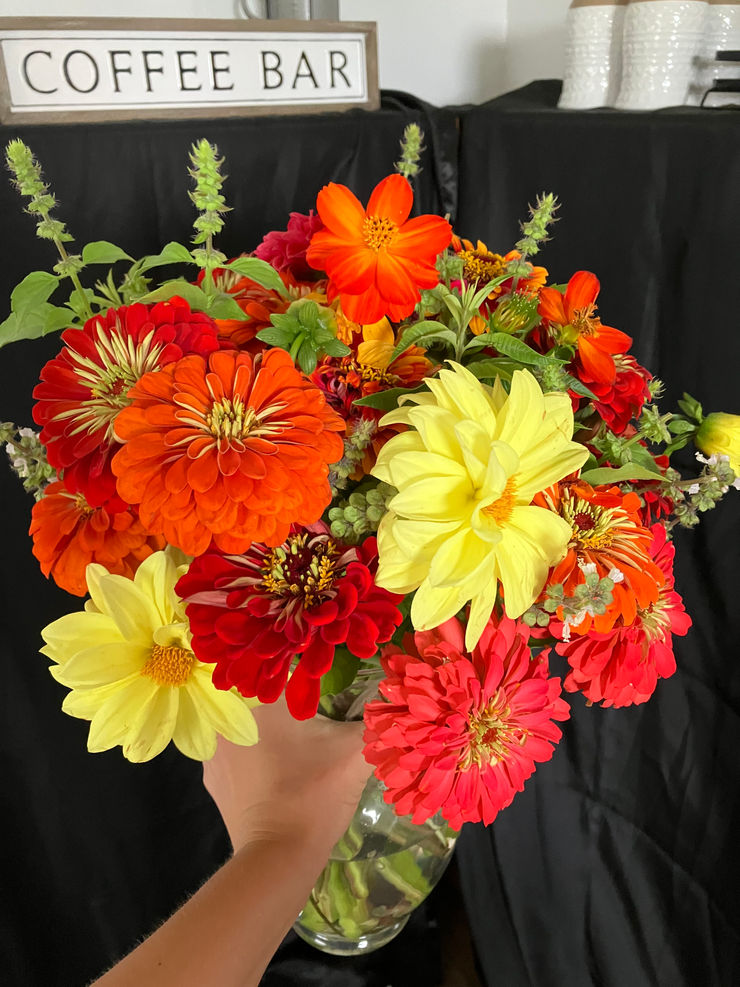
And don't forget — we're at the market every week! Stop by Gathered Local Foods Market Wednesday or Thursday from 4–6pm for our weekly pickup hours. Sample a featured product, grab your pre-order, or shop our back stock on the spot — think local meat, farm-fresh eggs, Iowa made hummus and pita, and flowers. No appointment needed, just come say hi.


Take Root | The Next Step


Last week, our team paused to ask ourselves two simple but important questions about the past quarter:
Who was impacted by our work? And how do we know?
It's easy to get caught up in the day-to-day of running a market, planning events, and keeping the gardens looking good. But when we stopped to really look at who we're reaching, the answers reminded us why the work we do at Mint N More matters:
Kelsey told us about how her family is now feeding themselves straight from their community garden plot. Andrew helped us build our herb spiral and was inspired to recreate one at home to grow herbs for his family. Denise learned to make sourdough bread and tame the starter after coming to our class-she's making it at home consistently now. Makayla is raising her son to love plants and grow up around healthy food. Linda is a regular at our classes and has built a sense of community through shared interests. Jessica found her footing doing things she'd never done before in a brand-new community. Jill found the push to update business practices and try new markets. Kelli taught customers to make a salad they'll actually make again at home. Vicki was able to source fresh, local vegetables in one convenient place keeping her on top of her healthy eating. Mackinzie found inspiration — and a little more confidence — from spending time in the garden. Maureen and Marissa found new ways to get their fresh produce to customers while keeping focused on growing. Plus our team has felt the pride and excitement from passersby at the community garden who shout out words of encouragement as they drive or walk by, customers who are happy to buy local produce and farmers who feel the support of our partnership.
None of this happens by accident. It happens because of you — the people who show up to our market, our events, and our farm visits, and the growers who trust us to help carry their work to more tables.
Want to be part of this work? We're always looking for hands to help — at the market, in the garden, or at events like the ones above. Fill out our volunteer form to let us know how you'd like to get involved. We will be sharing specific volunteer opportunities soon!
Thank you for taking root with us. We can't wait to see what grows next.
Rooted Reflection
This week, consider one small swap: pick up an item at Gathered or your local farmers market that you'd normally grab off a store shelf, and see how it feels to know exactly where it came from.
Stay Connected
We love sharing our progress, tips, and events with you. Follow us on social media for real-time updates and community engagement.
Missed a newsletter or want to find an old one? Find our archives on Substack!


Comments